

Contents:
What is contended broadband?
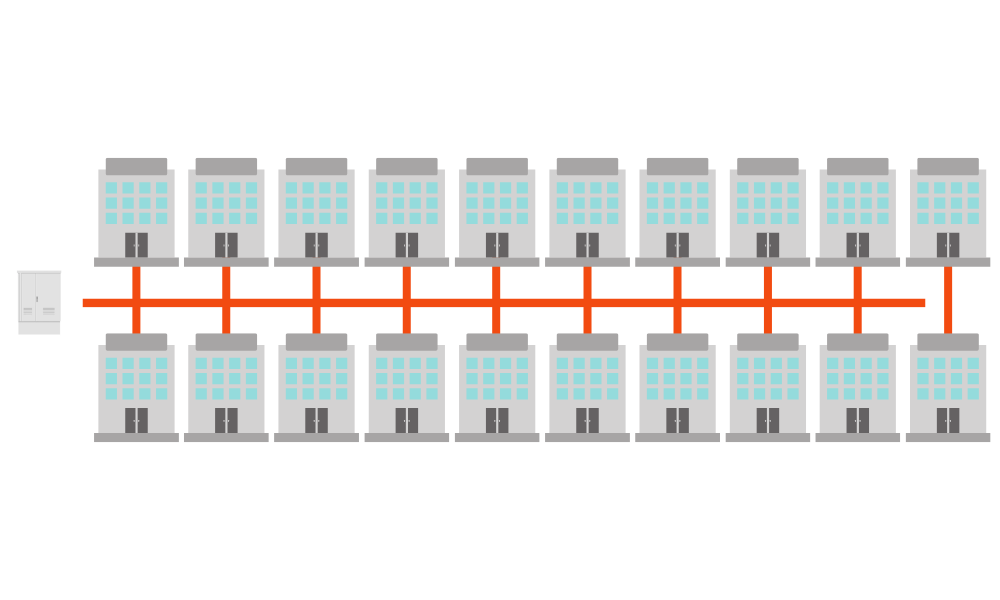
Contended broadband is an internet connection where bandwidth is shared among multiple users or businesses. Internet Service Providers (ISPs) allocate a certain amount of bandwidth to a group of customers, meaning that during peak times, network congestion can lead to slower speeds and reduced performance. This type of broadband is common in small business (and residential) settings where cost-effectiveness is a priority. Contention refers to the competition for bandwidth. If the contention ratio is 30:1 that means you are sharing the line and bandwidth with 29 other premises. Contention can occur at multiple points along the path to the Internet, including the backhaul from the telephone exchange to the providers core.
Residential Full Fibre services typically operate on a contention ratio of up to 100:1. Business Full Fibre services can vary from around 20:1 to 5:1 depending on the supplier.
Bandwidth: the maximum amount of data that can be transmitted over an internet connection in a given amount of time.
Pros of Contended Broadband |
Cons of Contended Broadband |
|---|---|
More Affordable: Contended connections are usually cheaper because the costs are shared among multiple users. | Fluctuating Performance: Performance can fluctuate depending on network congestion. |
Widely Available: This type of broadband connection is widely available across the UK. | Not ideal for critical operations: Businesses that rely on high-speed, always-on Internet may find contended broadband limiting. |
Sufficient for many business needs: A contended broadband connection is often sufficient for businesses with moderate broadband requirements. | Potential for latency issues: Slower response times can affect video conferencing, VoIP calls and cloud applications. |
Not all contended services are the same.
While contended broadband generally means shared bandwidth, the quality of service can vary significantly depending on the provider and the specific package chosen. Different providers have different contention ratios. One provider may deliver Full Fibre with a contention ratio of 20:1 whilst another may have a contention ratio of 5:1.
What is uncontended broadband?
Uncontended broadband provides a dedicated connection where bandwidth is not shared with other users. This means businesses have access to consistent speeds and reliable performance, regardless of the time of day. Ethernet services such as leased lines or Ethernet over FTTX provide uncontended broadband. Uncontended broadband is also commonly found in a data centre setting.

Pros of Uncontended Broadband | Cons of Uncontended Broadband |
|---|---|
Guaranteed Speeds: Businesses get a fixed amount of bandwidth without fluctuations. | Higher Cost: Since the connection is dedicated, pricing is higher than contended broadband. |
More reliable: No competition for bandwidth ensures stable connectivity, ideal for critical business applications. | Limited Availability: May not be accessible in all locations, particularly rural areas. |
Lower latency: Optimal for high-volume VoIP, video conferencing and real-time data processing. | Longer installation times: Setting up a dedicated leased line can take weeks or months. |
Scalability: Suitable for growing businesses that need a dependable connection for cloud computing and large file transfers. |
Do I need uncontended broadband?
The choice between contended and uncontended broadband depends on your business needs, budget and usage. For most small businesses uncontended broadband is not necessary, especially if the business is not overly dependent on Internet usage. If your business has lots of employees using the Internet simultaneously and/or has lots of critical online operations and is highly dependent on uninterrupted connectivity, then it may be worth considering uncontended broadband.
Overall
Choosing the right broadband service is crucial for business success. Contended broadband offers an affordable solution for small businesses with moderate internet needs, while uncontended broadband ensures high-speed, reliable performance for businesses that depend on seamless connectivity. By evaluating your business requirements and budget, you can select the best broadband option to keep your operations running smoothly and efficiently. We are always happy to discuss business connectivity and which service would be best suited to your needs. Get in touch on 0330 122 0550 or email