

What is IP Telephony?
How does IP Telephony work?
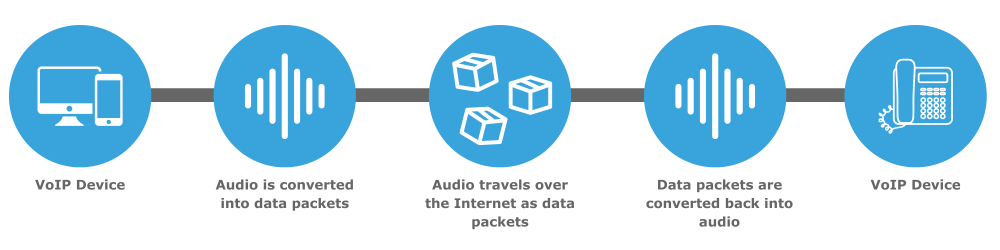
There are 3 stages to IP telephony calls:
1. Initiate the call
When you initiate a VoIP call, your device (be it an IP handset or VoIP application on a mobile device or computer) converts what you say (analogue voice signal) into digital data. This conversion process is called voice digitalisation or encoding and uses audio compression algorithms to reduce data size to optimise transfer efficiency. Digital voice data is broken down into small packets to be transferred across the network.
2. Transmission of data packets
Once broken down into data packets, your digital voice data is transmitted using Internet Protocol (IP). This is the standard protocol for the transmission of data over the Internet. Dynamic routing is used to ensure that data packets take the most efficient route to their destination. Different packets may take different routes depending on network conditions, congestion and other factors. When the data reaches its destination the packets are reassembled in the correct order.
3. Receiving the call and call termination
Once all of the data packets have been received and reassembled a process called decoding can then take place. Decoding converts the digital data packets back to analogue voice signals. The analogue voice signal is then delivered to the recipient of the call through the speaker of the handset or device they are receiving the call on, enabling 2-way communication between both parties involved in the call.
Key components of IP Telephony
VoIP Phones: These can be software-based (softphones on computers or mobile devices) or hardware-based IP phones.
Softphones: Software applications that provide phone functionality on computers or smartphones.
IP PBX (Private Branch Exchange): A central system that manages internal communication and routes external calls.
SIP Trunks: Virtual lines connecting IP PBX systems to traditional phone networks.
Gateways: Devices that convert signals between analogue and digital networks.
Network Infrastructure: Routers, switches, and firewalls necessary to support VoIP on a secure and stable network.
Types of IP Telephony Solutions
On Premise VoIP
On-premises VoIP refers to a phone system hosted and managed within a company's own physical infrastructure rather than being hosted in the cloud or managed by a third-party provider. In an on-premises VoIP setup, the necessary hardware, software, and servers are located at the business site, allowing the company full control over its phone system, including configuration, maintenance, and data security. On-premises VoIP is often chosen by businesses that prioritise data control, customisation, and have the resources and expertise to manage their own infrastructure.
Hosted VoIP
A Hosted VoIP solution is managed and maintained by an external service provider in a cloud-based environment, rather than being installed on-site at the business. This setup allows businesses to make and receive calls over the internet without having to handle the physical infrastructure or heavy technical maintenance themselves. Hosted VoIP is popular with small to medium sized businesses or those looking for a low-maintenance, scalable, and flexible phone solution. Because the infrastructure is hosted and managed off-site, businesses can focus more on operations without worrying about complex phone system upkeep.
Hybrid VoIP
Hybrid VoIP is a phone system that combines elements of both on-premises and hosted VoIP, allowing businesses to leverage the benefits of each. In a hybrid VoIP setup, a portion of the phone infrastructure is kept on-site, while other functions and capabilities are hosted in the cloud by an external provider. This approach provides flexibility, control, and redundancy, making it a good choice for organisations that have specific needs for both local and cloud-based services. A hybrid VoIP setup can work well for medium to large organizations that need the control and reliability of on-premises equipment but also want the flexibility, scalability, and advanced features that come with cloud-based VoIP. A hybrid approach also helps mitigate the potential risks associated with a purely on-premises or cloud-only system.
Unified Communications as a Service (UCaaS)
Unified Communications as a Service (UCaaS) is a cloud-delivered model for providing integrated communication tools and collaboration services. UCaaS combines various communication methods, such as voice, video, messaging, chat, file sharing, and presence, into a single platform that can be accessed across devices and locations. This allows users to seamlessly communicate and collaborate in real-time from virtually anywhere.
The process of migrating to IP Telephony from legacy systems
Deciding on the best IP Telephony solution and provider for your business
The first step in switching telephony system is to analyse what you currently have in place. What hardware, phone lines and associated software do you currently have?
Next you need to identify your needs and goals for the new system. Are you looking to make cost savings? Would you like to benefit from remote access, ease of scalability or specific advanced features? You also need to consider requirements such as the number of users, call quality, and whether you would like conferencing, voicemail or additional integrations. Would you like to have physical handsets or are softphones an option? All of these factors will help determine which IP telephony solution is best suited to your business.
VoIP relies on internet connectivity, so sufficient bandwidth is essential. Evaluate your current internet usage and whether or not an upgrade is required to support high-quality calls.
Some providers, such as CloudConnX, take a consultative approach and will help to guide you through these considerations and help you to find the best solution for you, as we know it can seem overwhelming. Providers that take this approach can often tailor solutions specifically for your business and make sure you aren’t overpaying for functionality you don’t require. Other providers will have set telephony packages with minimal ability to tailor them for individual business’ requirements so bear this in mind when choosing a provider.
Other things to consider when looking for an IP Telephony provider aside from features of the systems they offer include reputation and reliability, access to timely and effective customer support, and transparent pricing.
Setting up the new system
Once you have chosen a provider and decided on the best IP Telephony solution for your business’ needs, it is time to begin the transition from your legacy system. Much of the set-up process should be taken care of for you by your provider. Your provider should set up the new system for you and provide you with any required hardware. They should port any existing numbers across for you and test the configuration of the system to ensure proper voice quality, connection stability and functionality. Staff training is a crucial step in moving over to IP Telephony, and your provider should be able to provide training on how to use your new telephony system, the features available and how to troubleshoot any common issues. Your provider should ensure that making the switch from legacy telephony to IP telephony causes little to no disruption for your business.
IP Telephony and Security
VoIP systems can make use of advanced security measures to protect business communications. This may include end-to-end encryption to protect call privacy, firewalls to prevent unauthorized intrusions into the network, user authentication to ensure that only authorised personnel can access the system, and fraud detection to prevent hacker attacks. Implementing these security measures helps protect sensitive business information, reduces risks of service disruptions, and ensures regulatory compliance. Additionally, secure VoIP systems can improve business continuity, enhance user confidence, and reduce the costs associated with fraud or data breaches.
Encryption
Encrypting VoIP calls can help to protect voice data from interception and eavesdropping. Remote users can be encouraged to use a Virtual Private Network (VPN) as an additional layer of encryption and protect communication over public networks.
Network Segmentation, Firewalls and VLANs
Making use of Virtual Local Area Networks (VLANs) to isolate voice traffic from other data traffic on a network can add an additional layer of security, improve performance and simplify management.
Implementing a firewall to monitor and control VoIP traffic can help to prevent unauthorised access and limit exposure to potential attacks.
User Authentication
Ensure that all users have strong passwords for VoIP accounts and enforce Multi-factor Authentication where possible to help prevent unauthorised access.
Network Monitoring
Many VoIP systems include monitoring tools for tracking latency, jitter, and packet loss which can indicate security issues.
Backup and Disaster Recovery
Keep regular backups of VoIP system configurations and call data, so you can quickly restore service after a security incident or system failure. Develop a disaster recovery plan for VoIP systems, ensuring backup infrastructure is in place to resume communication in case of failure.
Compliance and regulatory requirements
Ensure the IP telephony system complies with industry regulations, such as GDPR, HIPAA, or PCI-DSS, which may require specific data protection and encryption measures. Enable logging and auditing of VoIP activities to track access, changes, and unusual behaviour, which can support forensic analysis if a security incident occurs.
IP Telephony and the PSTN Switch Off
The impending PSTN switch-off, set for 2027, is driving businesses to transition from traditional analogue and ISDN phone lines to internet-based IP telephony. This shift, driven by the high cost of maintaining outdated infrastructure and the limitations of analogue networks, requires businesses to adopt VoIP to avoid service disruptions and ensure continued communication. By transitioning now, you can not only avoid the disruption of the PSTN phase-out but also gain a modern, scalable communication system that supports remote work, enhances customer experience, and future-proofs your business’ infrastructure. If you are not aware of the upcoming switch off, you can read our handy guide here.
Summary
IP telephony is a powerful tool for modern businesses, offering flexibility, cost savings, and advanced functionality. By understanding your organisation’s communication needs, choosing the right solution, and following best practices for setup and security, your business can benefit from a robust, scalable, and efficient communication system that can grow with your organisation.
If you are considering IP Telephony for your business our team would be happy to advise you. Reach out on 0330 122 0550 or email us at